Values vs. Identity: Public Support for Pro-Democratic Mobilization in Brazil (Under Review)
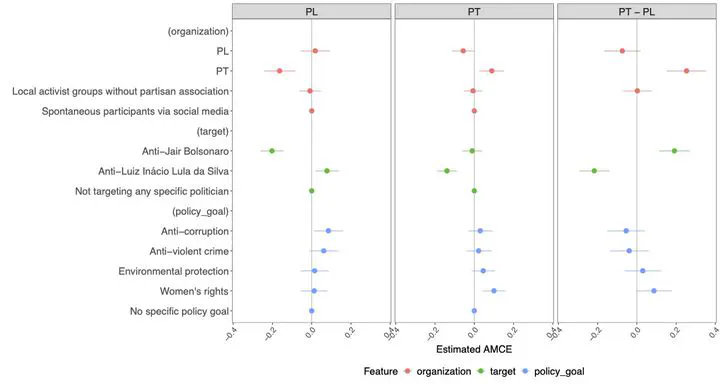 Differences in Conditional AMCEs by Party ID
While scholarship extensively documents how civil resistance drives democratization, we lack a clear understanding of why pro-democratic movements trigger backlash in some contexts but not others. Specifically, the literature has yet to untangle how citizens weigh a movement’s democratic values against their own partisan identity when deciding to offer support. This paper investigates the conditions under which pro-democratic protests overcome partisan hostility to mobilize broad public legitimacy. Using a conjoint survey experiment with 1,245 respondents in Brazil—a critical case of recent autocratization reversal—I isolate the effects of protest framing (pro-democratic vs. anti-democratic) and the political alignment of protesters. I find that while protests emphasizing core electoral principles receive the highest baseline support, partisan-branded mobilizations face widespread public skepticism. Partisan voters are also more likely to support protests associated with their own political camp. Crucially, however, this partisan bias is constrained by a robust normative commitment to democracy: respondents consistently reject protests advocating anti-democratic objectives, even when employed by their preferred political camp. These findings demonstrate that while partisan cues can fragment public support for collective action, shared democratic norms remain a powerful constraint on partisan polarization.